04/07/2026
Blind since birth, Lindsay Ball doesn’t back off from challenges, whether overcoming her own or helping others do the same.
A former Paralympian skier, the SUNY Cortland assistant professor of physical education is now a distance runner. And thanks in part to a training team she’s found on campus, she’s preparing to run farther than most people — legally blind or not — will ever try.
After attempting five marathons and completing four of the 26.2-mile races, Ball is now training for the Cayuga 50K — about 31 miles — at the end of May. It will be her first ever ultramarathon.
Already a serious test of grit and endurance, Ball must do it seeing only shades of light instead of mile markers or cracked pavement. Thankfully, that’s where fellow Cortland professor and ultramarathoner Kevin Dames comes in.
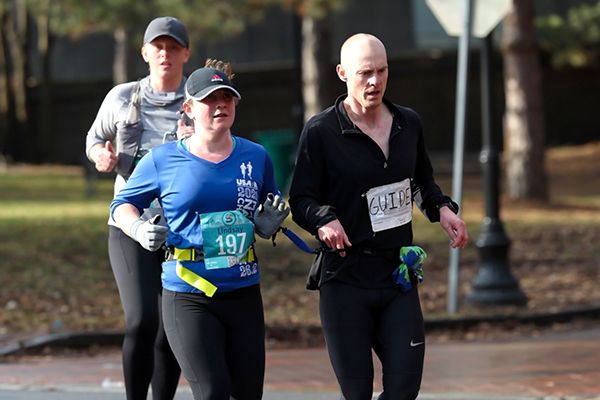
Acting as her guide, Dames, of the Kinesiology Department, trains with Ball and spots what she can’t.
“Most of the time we just talk or focus on moving forwards,” Dames said. “A quick word about uneven pavement as needed then back to talking.”
Most recently they completed the Syracuse Half Marathon in March. It’s a tandem born of a shared appreciation for running and of pushing themselves to new heights.
Before that they took on a trail run through snow this winter, which Dames described as a timed race where participants run for as long as you want before stopping. Despite the cold and terrain, Dames said they ran a couple hours and got to socialize with other runners.
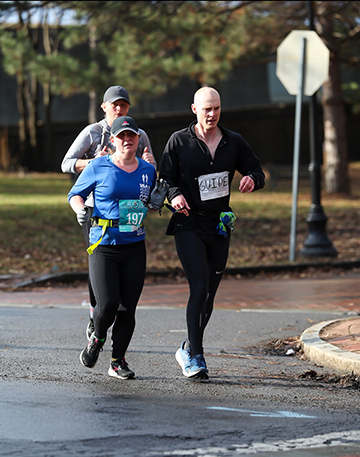
Ball hopes to expand their running group soon. In addition to Dames, sophomore exercise science major Ben Wasser also runs with her. She’s looking for more runners to join them and possibly learn to guide alongside her.
“The more guides you have, the more flexibility there is in the schedule,” she said. “And then it’s not all put on like one person, which makes it much easier.”
For others interested in being a guide, Dames described communication as key to finding out what a runner expects. He recommended United in Stride as a useful website.
“Running is a great modality for getting to know other people,” said Dames, who specializes in biomechanics, more specifically gait and postural stability. “For me, conversations somehow flow much easier when moving. Most of my miles are solo so I really enjoy opportunities to run with others.”
Ball and Dames began by running indoors at the Student Life Center’s three-lane track to practice cues for turns and avoiding other people. Then they went outside to develop a sense of sloped sidewalks, potholes and other issues that could appear.
For Ball, ultramarathons feel more fun compared to lesser distances, with less focus on speed and more on the experience. She appreciates the balance of enjoying her time running with competing.
“I think it’s really just seeing what I can do, what am I capable of,” Ball said. “You don’t work in academia if you’re not an overachiever. It’s one of those things where I want to have a new goal and always need to be working toward something.”
In the past, that desire has led her to face off with some of the world’s best. Qualifying as a downhill skier in the 2014 Paralympic Games in Sochi, Russia, Ball injured her ACL months before the event before making it back to the slopes in time to race.
Since then she’s pursued running and completed a Half Ironman triathlon. The 70.3-mile distance consists of a 1.2-mile swim, 56-mile bike ride and 13.1-mile run.
Now, with the upcoming 50K race, Ball wants to push herself past her old limits.
“I think I want to try and see how the 50K goes,” she said. “My thought was, let’s start with the 50K first then go from there. I don’t know if I can do what Kevin does and run through the middle of the night.”
Ball is used to shattering personal goals, and she’s poured that tenacity into helping others. She also serves as a board member and works with the Maine Organization of Blind Athletic and Leadership Education, a sports camp for blind and visually impaired youth.
“Our society and our systems don’t emphasize that blind or visually impaired or disabled kids have the skills and ability to move, and so we kind of limit their options for them,” Ball said.
She stressed that her work at the camp is to give kids more of those chances if they want them, and then to reinforce the activities that they enjoy.
“It doesn’t have to be running, it doesn’t have to be skiing, but to find something that they love enough to move their body throughout their life is really why I’m doing what I'm doing.”